Main Article Headline |
Article Sub Headline |
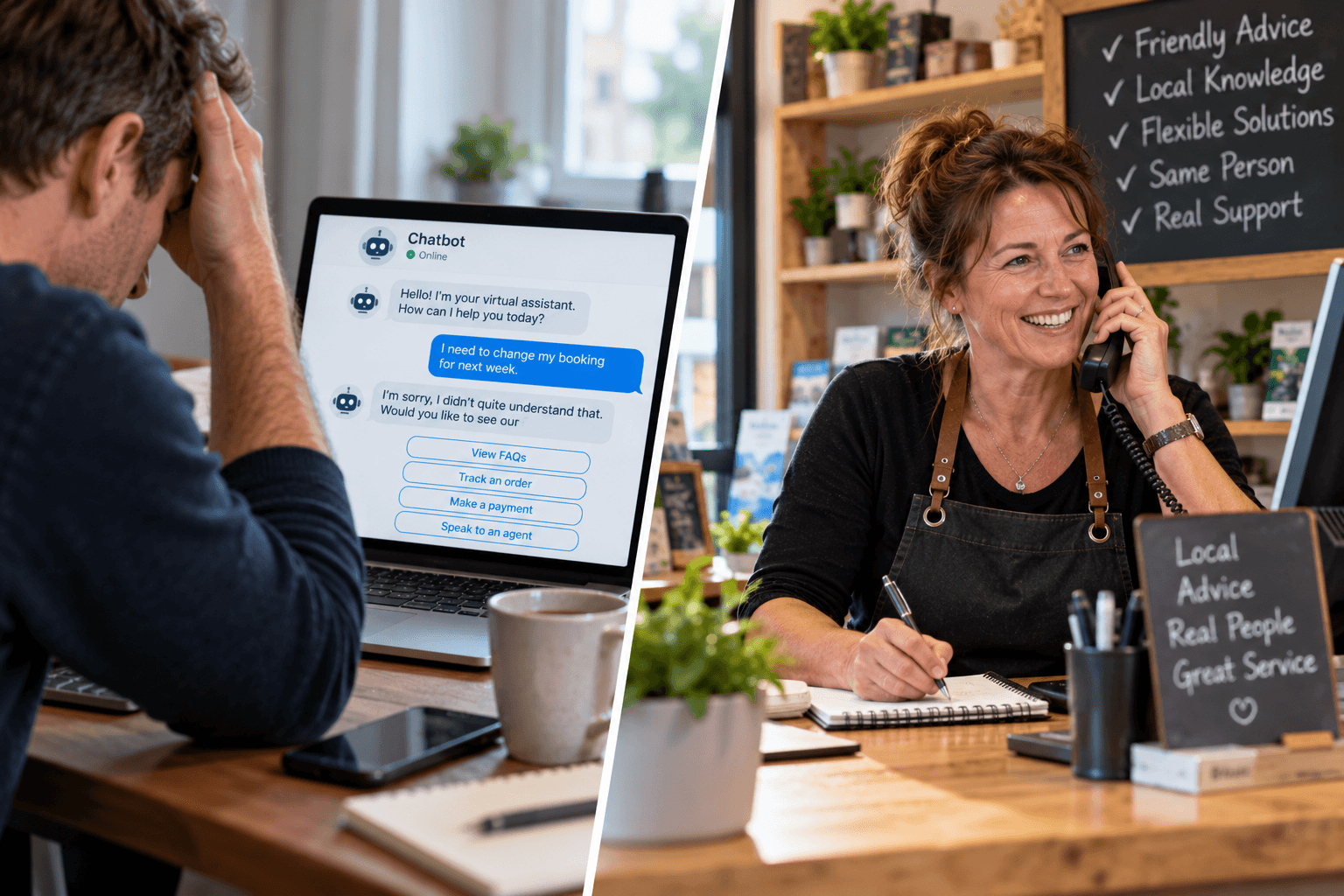
“Hello! I'm your virtual assistant. How can I help you today?”
You explain the problem.
“I'm sorry. I didn't quite understand that.”
You explain it again.
“Would you like to read our frequently asked questions?”
No.
You would like to speak to a human being.
“Great! Here are five articles you might find helpful.”
At this point, you're considering whether the chatbot has a manager you can complain to.
Welcome to the future of customer service.
Now imagine calling a small local business.
Someone answers.
You explain the problem.
They say, “Ah, yes. I know exactly what you mean.”
And within two minutes, you're getting somewhere.
Sometimes being smaller is a competitive advantage hiding in plain sight.
The big-business advantage isn't everythingLarge companies have plenty going for them.
They can negotiate purchasing deals, invest in sophisticated systems and advertise to enormous audiences.
They may have specialist teams for marketing, finance, technology and customer service.
A small independent business can't always match those resources.
But it doesn't necessarily need to.
The question isn't whether you can become a smaller version of a national company.
It's whether you can offer customers something the larger company finds harder to deliver consistently.
That might be specialist knowledge.
Flexibility.
Personal attention.
Or the simple pleasure of speaking to someone who knows what they're talking about.
The customer who doesn't want to explain everything twiceImagine hiring a local tradesperson.
You describe the problem.
They ask sensible questions, explain what they can do and tell you when they're available.
Now imagine dealing with a large organisation where the first person takes your details, the second asks you to repeat them and the third says the information hasn't transferred across.
The larger business may still deliver an excellent service.
But the experience has already become more complicated.
Small businesses can sometimes avoid those handovers.
The person answering the enquiry may be the person doing the work.
The person making the decision may be the owner.
And the customer may feel that somebody is taking responsibility rather than passing the problem around.
That's valuable.
Especially when the customer is stressed, confused or short of time.
Your size can make you faster
Consider a customer who asks a slightly unusual question.
In a large organisation, the answer may need to pass through several departments.
Policies need checking. Managers need consulting. Someone has to find the right person.
A smaller business may be able to make a decision much more quickly.
Can we accommodate that appointment? Could we adjust the order? Is there a better way to solve this particular problem?
Sometimes the owner can answer immediately.
Of course, flexibility has limits.
Businesses still need to respect safety, legal obligations, staff capacity and commercial realities.
But being able to make a sensible decision without convening a committee can be an advantage.
Especially when the alternative involves a support ticket and a promise that somebody will respond within five working days.
Don't confuse personal service with being available every minuteThere's a trap here.
Small business owners sometimes believe excellent customer service means answering every call, message and email immediately.
Including evenings. Weekends. Holidays. And possibly while attempting to eat dinner. That's not sustainable.
Personal service doesn't require unlimited availability.
It requires clear expectations and reliable communication.
Tell customers when you're available.
Explain how quickly you normally respond.
Use booking systems, helpful website information and automated acknowledgements where they genuinely make life easier.
Technology isn't the enemy.
Used well, it can give a small team more time to provide the human attention customers appreciate.
The aim isn't to avoid automation.
It's to automate the right things.
Let the machines do the boring bits
Here's where small businesses can have the best of both worlds.
A booking system can reduce the time spent arranging appointments.
An automated reminder can help customers remember a visit.
A well-organised customer record can prevent people having to repeat information.
A useful FAQ page can answer straightforward questions outside opening hours.
And AI tools may help staff prepare routine information, provided the results are checked and customer data is handled appropriately.
None of that has to make the business feel impersonal.
Quite the opposite.
If technology reduces administration, staff may have more time for the conversations that actually matter.
The best use of automation isn't necessarily replacing the person.
Sometimes it's making the person easier to reach.
Give people a reason to choose the smaller business
“Friendly, professional service” appears on an extraordinary number of business websites.
It's not a bad promise.
It's just rather difficult to distinguish from everybody else's.
Instead, explain what customers actually experience.
Do they speak directly to the person doing the work? Can they ask questions before booking? Do you offer specialist advice? Can you adapt a service to their needs? Will they deal with the same person throughout?
These are tangible reasons to choose a business.
And they're more convincing when supported by genuine customer feedback and consistent delivery.
You don't have to pretend your business can do everything.
You have to make clear what it does particularly well.
The next customer might prefer a humanNot every customer wants a phone conversation.
Some would much rather book online, send a message or find an answer without speaking to anyone.
That's fine.
Good service means respecting how customers prefer to communicate where reasonably possible.
But when something is complicated, unusual or important, access to a knowledgeable person can make an enormous difference.
That's an opportunity for independent businesses.
You may not have the biggest advertising budget.
You may not have the most advanced chatbot.
You may not even have a customer service department.
But you might have something customers remember.
Somebody who listens, understands and actually helps.
And in an increasingly automated world, that can be a very good reason to come back.
The Business Pulse Question
Would you rather deal with an excellent chatbot or an average human customer service representative?
And what's the best example of personal service you've experienced from a local business?
Tell us in the comments. We'd love to hear which Cambridgeshire businesses are getting the human side of customer service right. |
0 Comments
Join the conversation
Be the first to comment
Share your thoughts above.