Main Article Headline |
There's nothing wrong with being a one-person business. So why do so many entrepreneurs write about themselves as though they employ half of Canary Wharf? |
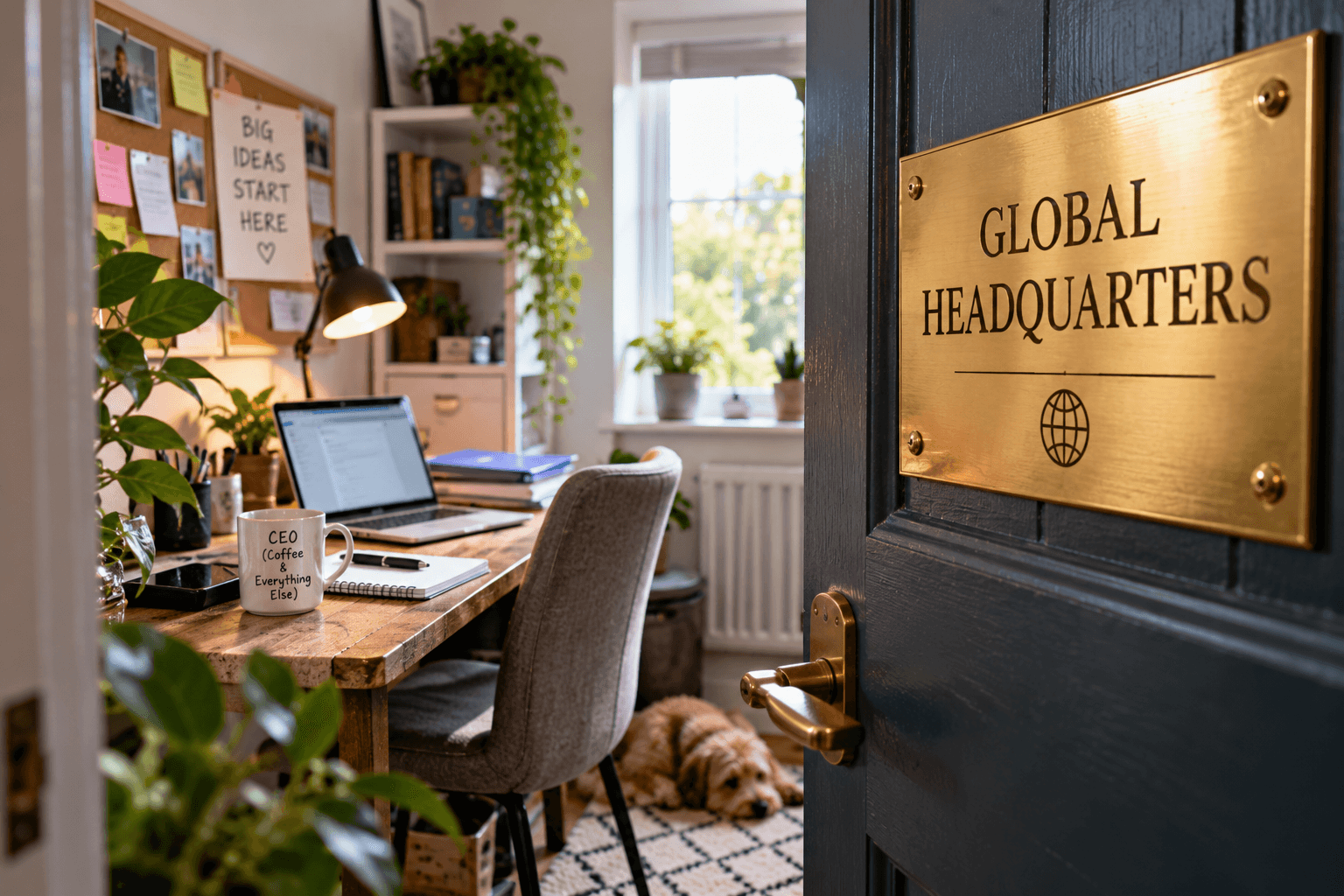
Somewhere in Cambridgeshire, a business owner is sitting at the kitchen table, answering emails between putting the washing on and wondering whether there's any milk left.
The business has one employee.
One laptop.
And a website that proudly announces:
“Our dedicated team of industry-leading specialists delivers innovative solutions to clients across multiple sectors.”
That's quite a lot of responsibility for somebody who also has to remember to put the bins out.
Of course, there's nothing wrong with running a business from home. Some excellent companies began in spare bedrooms, garages and kitchen cupboards.
The question is why so many business owners feel they need to disguise that fact.
The mysterious case of “we”
Spend a little time browsing business websites and you'll notice something peculiar.
Almost everybody is a team.
Even when they're not.
The freelance designer becomes “our creative department”.
The independent consultant refers to “our leadership team”.
A business consisting of one person and a subcontractor who helps occasionally suddenly has “a network of global specialists”.
Sometimes those descriptions are entirely legitimate.
A sole trader can work with an extensive group of collaborators, and a small company may genuinely serve international customers.
But sometimes the language is doing a lot of heavy lifting.
The owner worries that saying “I” sounds less professional than saying “we”, so the website adopts a corporate personality that bears little resemblance to the business itself.
The result can be oddly impersonal.
Customers looking for a specialist with experience and judgement are instead introduced to a fictional boardroom.
Being small isn't a confession
There's a difference between appearing professional and pretending to be something you're not.
A self-employed accountant doesn't need twelve colleagues to provide an excellent service.
A skilled photographer doesn't become more talented because their website refers to a creative studio.
A consultant's advice isn't automatically better because they describe themselves as a managing director.
For many customers, knowing who they'll actually deal with is reassuring.
If you're the person doing the work, say so.
If you have a small team, introduce them.
If you use trusted subcontractors or specialist partners, explain how that works when it's relevant.
None of this requires revealing your private life, home address or every detail of your business arrangements. It simply means presenting the company accurately.
Professionalism comes from competence, reliability and the way you treat customers, not the number of imaginary departments on your website.
The website written by a committee of robots
Then there's the language.
Consider this entirely fictional opening paragraph:
“We leverage cutting-edge methodologies to deliver bespoke, customer-centric solutions that empower organisations to unlock their full potential.”
Splendid.
What do you actually sell?
A customer shouldn't need to complete a business studies course to understand your homepage.
Compare that with something more specific:
“I help independent retailers build websites that customers can actually use.”
Or:
“We're a small team of commercial electricians working with shops, offices and restaurants across Cambridgeshire.”
Neither statement is particularly glamorous, but both give the reader useful information.
Good business writing doesn't need to sound casual or jokey.
A solicitor, financial adviser or engineering specialist may need a more formal tone than a local café.
What matters is clarity.
If customers can't tell what you do, who you help and why they should trust you, a paragraph full of impressive adjectives won't rescue the situation.
Your personality is not a business liability
One of the advantages of an independent business is that it can have a recognisable personality.
A restaurant owner might have strong opinions about what belongs on a pizza.
A dog trainer may have a wonderfully dry sense of humour.
A specialist retailer might be genuinely obsessed with the products they sell.
Those details can make a business memorable.
They also give people something to talk about.
Of course, personality isn't a substitute for expertise. Nobody wants their accountant to be entertaining but incapable of preparing accurate accounts.
The trick is allowing some humanity into the business without undermining the work.
You can be knowledgeable and approachable.
Professional and funny.
Experienced without sounding as though every sentence has been approved by a committee.
And if your business has an interesting story, tell it. Readers are often more interested in why somebody started a company than in another paragraph about a commitment to excellence.
The photograph of people who don't work there
We've all seen them.
The immaculate business team gathered around a conference table, laughing at something apparently hilarious on a laptop.
Everyone is perfectly dressed. The office is spotless. Nobody appears to have a deadline.
It's a lovely photograph.
Unfortunately, none of those people works for the company.
Stock photography can be useful, particularly when illustrating a service or concept. There's no rule that every business needs an expensive professional photoshoot.
But using generic images in a way that suggests they show your actual staff or premises can create the wrong impression.
If you're a small independent company, genuine photographs of your workplace, products or work can sometimes tell a stronger story.
And if you prefer not to appear in photographs, there are plenty of ways to illustrate what you do without inventing a workforce.
Three changes that could make your business sound more believable
Here's a small experiment.
Open your website and read the homepage as though you've never heard of the company.
First, look for descriptions that could apply to almost any competitor.
If you removed the business name, would readers still know what you actually do?
Next, check whether the language accurately describes how the business operates.
If you work independently, does the website explain the benefit of dealing directly with you?
If you have a team, can customers understand who does what?
Finally, look for something distinctive. A specialism, an interesting origin story, a particular way of working or a genuine reason customers choose you.
You don't need to rewrite the entire website.
One clearer headline, a more believable introduction or a specific example of your work might improve it considerably.
And if you're unsure, ask somebody unfamiliar with your business to explain what they think you offer after reading the homepage.
Their answer could be enlightening.
Possibly alarming.
But enlightening.
You don't need a global headquartersThere's nothing wrong with wanting to grow a business.
Today's sole trader might eventually employ twenty people.
A small Cambridgeshire company might develop customers around the world.
Ambition is a good thing. But you don't need to borrow the language of a multinational company to be taken seriously today.
If you're excellent at what you do, explain that clearly and show people the evidence.
If customers deal directly with you, make that a strength.
If your company has an interesting personality, don't automatically edit it out.
Because the next customer might not be looking for a global solutions provider with an executive leadership team.
They might simply want somebody capable, trustworthy and easy to work with.
And you can provide all three without buying a bigger desk.
The Business Pulse Question
What's the most ridiculous piece of corporate jargon you've encountered on a business website?
And do you prefer a small business to say “I” when it's one person, or does “we” sound more professional?
Tell us in the comments. We'd love to hear what makes a business website feel genuine or completely unbelievable. |
0 Comments
Join the conversation
Be the first to comment
Share your thoughts above.